Hey world!
On today's drawing lesson you will learn how to draw this fish, and fish in general!
This is the third lesson on my "Super Simple Series"!
You can find more information and lessons from this series here: Super Simple Series (link will open in new window).
This lesson will be divided differently:
1. A detailed how to draw fish lesson.
2. An "infographic", summerizing the entire lesson.
1. How to Draw a Fish - Step by Step
Here is the whole process it took to draw this fish, and some more important tips on how to draw fish in general.
fish!
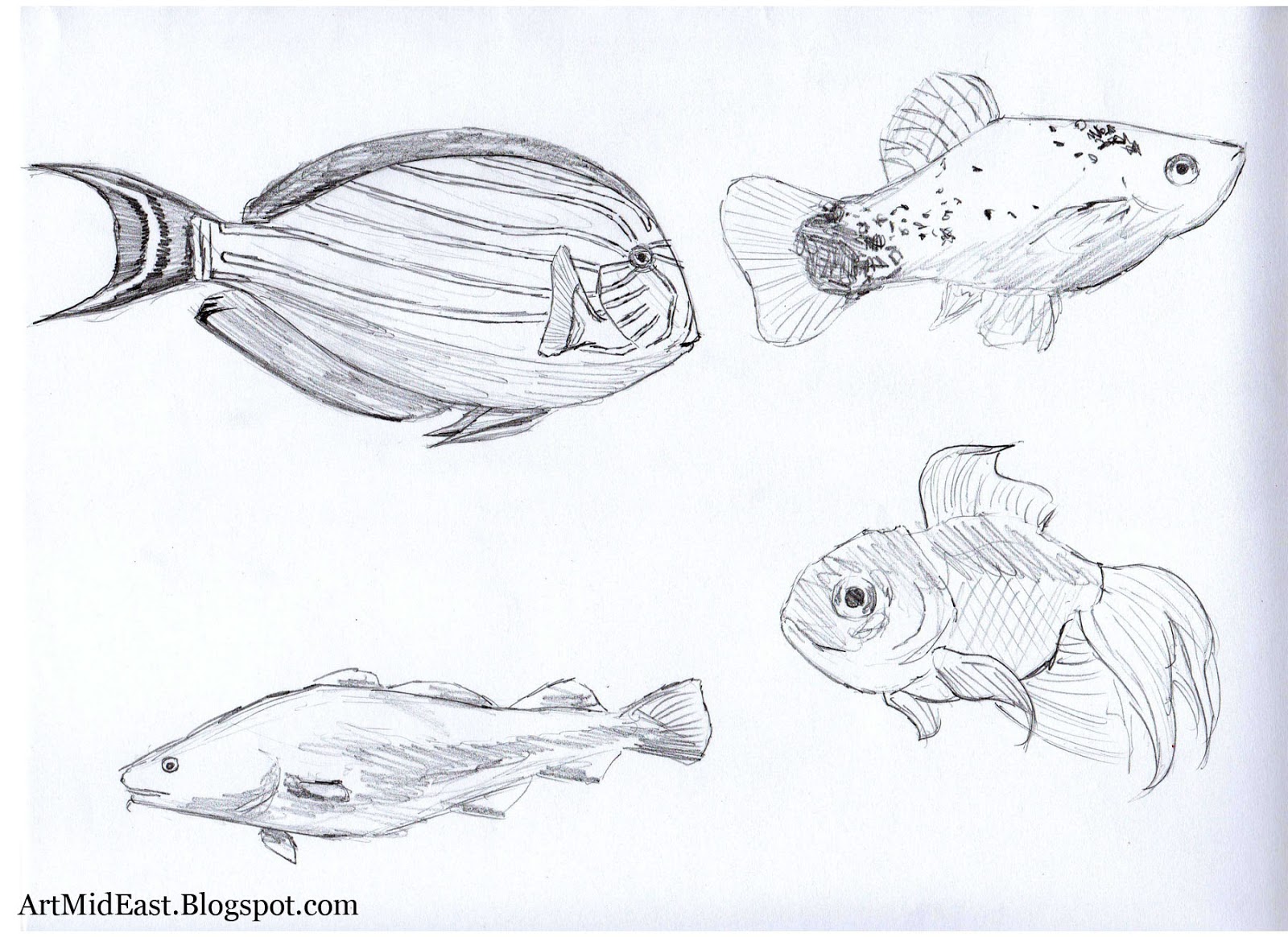
Here are a few drawings I've made, some of which are based on pictures I found on google.
After doing many of these, here are some general insights that helped me:
A. Most fish's bodies are actually built in a similar way. There are a few variations of body and fin shapes and sizes, but most of it is very similar. Consider these examples:
The fish look quite different from one another, but they all have fins on their top, size, tail, and bottom. Also, their bodies are shaped almost exactly the same. The only thing making a difference is their fins (which broaden / shorten the body's shape and size).
B. The gills are located right between the face and the side fins.
C. The scales are visible mainly on the bottom part of the body. Light that comes from the top (from the water's surface) creates a shinyness that hides the scales.
D. On the fins, there are sort of small "arms" that split into 2 parts (This is seen in the infographic too.
I saw this happen in many other fish. Do a little search [=
Now lets move on to the drawing process.
Step 1 - The body's front:
Draw two Perpendicular lines. The upper line is twice the length of the bottom line. Also make a small vertical line where I drew one. This will be used later to draw the mouth.
Step 2 - The body's center and back:
Draw the rest of the body using semi-straight lines. What I basically did was:
- Connecting another straight line to both lines from the previous step.
- Connecting a more curved line from these two lines, that leads to the back part of the body.
Also draw a small box on the back part of the body. This will help us with getting the tail fin on the next step.
Step 3 - The fins:
Draw the fins, using very basic triangles and squares. The only fin which is not triangular is the bottom back one, which is basically a curved rectangle. Make sure that you draw to connection of the back tail fin the way I did, to the small square from the previous step.
----
Check out my new website and subscribe for a FREE eBook! (=
LironYan.com
----
Step 4 - The face:
Draw the mouth using the guide line we drew earier. Notice that the lower "lip" protrudes more then the upper one. Also draw the eye, which is simply a black circle inside a white circle. Also draw the gills. As I said before, they are located between the side fin and the face (I didn't know that prior to making this lesson [= ).
Here is a zoom in on the face, isn't he beautiful?
Step 5 - Details of the fins:
Draw the small "arms" I talked about earlier. Notice again how the top fin's arms are splitting into 2 smaller "arms". Geez, there must be a scientific term for this, if anyone here happens to be a fish expert, please share it with the rest of us (=
Step 6 - Rounding the body and fins:
This step is barely visible here, but it is very important. Remember how we drew the body and fins based on straight lines and shapes? Now it's time to round the corners and curve the lines a little, as praparation for the inking. You can see what I did mainly on the connection of the tail, and the tail's fin.
Step 7 - Inking / Darkening
Ink / Darken the correct lines. Make sure you ink and darken the round lines we drew, and not the earlier, straighter lines.
Step 8 - Scales, texture and shading
Draw the scales. I used very simple cross hatching and quick lines, although you can take your time and draw more details. I also drew a darker area, beginning at the gills and ending at the tail. This kind of thing happens mostly on smaller fish. These fish tend to have a more transparent skin and body, so you can see their inside a little. Again, if any fish expert here has any idea what this dark area is, let us know [=
If you want to learn more on texture, shading and cross hatching, check out these drawing lessons as well: Sketching and Shading Techniques and How to Sketch - Sketching techniques (Elaborated).
Now all that's left to do is to erase the red pencil lines...
and here is your fish!
2. How to Draw a Fish - Step by Step - Summary
====================
With this I'll end today's lesson on how to draw a fish.
Follow me on Facebook, Twitter and Pinterest (With the buttons on the top of the right side bar) to see more pictures of me preparing this lesson, and share this lesson with your friends!
Next lesson will be on a badass animal (actually one that eats fish), can you guess which one.....?
Also, check out my new website and subscribe for a FREE eBook! (=
LironYan.com
Until next time,
- Liron
Read More
Hey people!
In today's drawing lesson you will learn
how to draw a Butterfly! This is the second lesson on my "Super Simple
Series"! You can find the first one here: How to draw a Lion - Step by step.
Read THIS post
to learn more about SSSeries.
Also, I've added an archive, including All of my drawing lessons. Feel free to check those out and maybe find older gems [=
This drawing lesson will be divided into two parts:
1. An "infographic", including the entire lesson, in a brief version (click to enlarge).
2. A more detailed lesson afterwards.
1. How to Draw a Butterfly - Step by step (scroll under the picture for part 2):
2. How to Draw a Butterfly- Step by Step: More in depth
For those who are interested in a more elaborated version, here is some more on the drawing process.
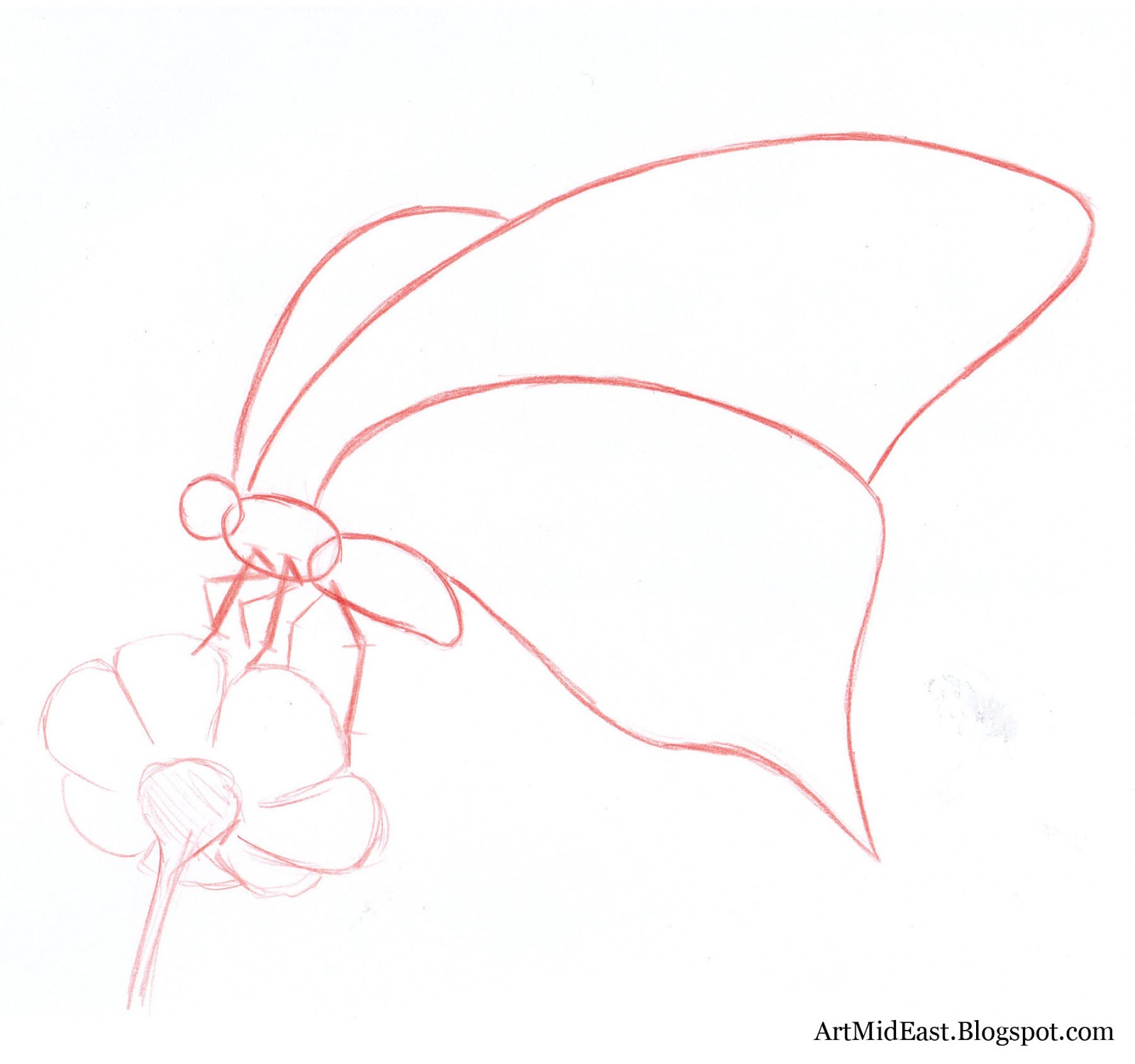
Step 1 - The body:
The body is composed of 3 oval shapes, one for the head, a second one for the middle part of the body and a third one for the back part. The head is round, and the two other parts are elliptic.
Step 2 - The wings:
I added the wings. These are divided to two sections each. On the left wing you can't see the two parts, only the top one, since it's blocked by the right wing. I won't elaborate on the shape of the wings, since these vary A LOT. You can pretty much improvise and exaggerate a bit here, it all works. If you want to be accurate though, google "butterfly" and you will see many examples.
Step 3 - The legs:
Here you can see I added the legs. These are pretty simple. There are three legs on each side, making it a total of 6 legs. Each of the legs is divided to 3 parts.
Step 4 - Details of the head:
OK, so I drew the details of the head. There are two huge eyes (in comparison to the size of the head), one of them is almost entirely bocked from our vision by the head. I also added the antennae and proboscis (which is the pipe that sucks food).
Step 5 - Details of the body and wings
Here
I added details to the body and wings. I found that some butterflies have this fur like cover over their body, which I indicated lightly here. I also divided the back part of the body, and added a preparation for the details on the wings.
Step 6 - Inking
Here I inked almost all of the butterfly, except for the wings. I only drew the correct lines with ink (skipping over most of the body's ovals, and inking the fuzzy "fur").
Step 7 - Wings
Now we officially finished with the wings. I added a texture I saw in many butterflies. Feel free to change it on your drawing. Maybe even invent one of your own!
Now it's time to erase the pencil, and wrap this drawing up...
There you go!
How did your butterfly turn out? Feel free to upload your own drawing and share the link here in the comment box [=
====================
That wraps up today's lesson on how to draw a butterfly.
Again, Let me know how this new format is working out for you.
Follow me on Facebook, Twitter and Pinterest (With the buttons on the top of the right side bar) to see some pictures (and not scans!) of the process that didn't make it here. And as usual, please share this lesson with other people who may be interested, maybe even your kids!
And until the next drawing lesson....
- Liron [=
Read More
Hey people of the world!!
Today I want to inform you of some changes I'm making, and to present to you..... The Super Simple Series!
I feel like my drawing lessons are really in depth, and full of quality information. I do however want to try something a bit different. I wanted to make a series of lessons that will be good not only for intermediate artists, but also for beginners and kids.
So that's what this series of drawing lessons is all about. Simple and easy lessons. Good for kids and beginners. Step by step. I still don't know how many lessons will be in this series, but for now I assume it to be around 6.
====================
Drawing Lessons in the SSSeries (list will be updated):
1. How to draw a Lion
2. ?
====================
Please let me know if this improves the quality and the ability to learn from the lessons. If it does, I might stick with it for a longer while....
And also make sure you follow me on Facebook, Twitter and Pinterest (buttons to the right) for more cool stuff that don't make it to the drawing lessons.
Until next time....
- Liron
Read More
Hey world!
In this drawing lesson, you will learn how to draw clothes and folds!
The lesson will be built in a way that will allow you to build a good understanding of the basics, and to continue learning and improving on your own!
Before we begin with the drawing lesson itself, let me make something clear. Drawing folds and clothing is SUPER easy! The reason I say this, is because very little technique is actually required (of course - with some exceptions). The challenge in drawing folds in a realistic way however, is the fact that it does require a good understanding of how folds and fabric "behave" in different situations.
But, once you get the basics down, it becomes really simple, and my goal is to get you through the basics, so you can continue your journey by observation and self studying folds and clothing in more depth.
But enough with that, lets start drawing! We will begin with the basic types of folds.
Types Of Folds
Here I will present the basic types of folds. Some of these overlap, and some contain others within them. study the folds carefully, and create them on your own. My suggestion is to actually grab a small towel and follow my instructions. Do this, and you will understand these in no time!
Spiral folds
 |
| Click image to enlarge |
These are the type of folds that occur when a piece of fabric is "squeezed" on the body it is on. In order to understand this, wear a long sleeved shirt or a sweater, pull your sleeves up and look at the folds created. This type of folds is also common on some types of curtains, as well as waistbands that have a rubber band inserted into them (the rubber band pulls the fabric and creates these folds).
Notice I drew a simplified, red colored version to help you understand the basics of this type of fold. That's it for the spiral folds!
Zigzag folds
Here is the zigzag fold in all of it's might!
This fold occurs on the inside part of a fabric that is was bended many times, for example - in pants, behind the knees. Another good place to look for them is wearing a jacket and slightly bending your arms.
This type of folds looks sort of like square-ish diamonds, created by zigzagged lines. I find these pretty easy to draw, since you can throw a couple of zigzagged lines and that's about it (not taking into account the shading). Again - look at the red simplified version.
Something I will point out in a later part of this drawing lesson, is the thickness of the fabric. Look at how the two right examples are of thinner fabrics, and notice how it influences the thickness of the folds. We will see more of this in future examples.
For more in depth explanation, check out my new eBook, which is The BEST, cheapest resource out there on drawing FOLDS and CLOTHES. Get your copy now and MASTER this skill-set!
Diaper folds
Here is a fun one....
Diaper folds are created when a fabric hangs on two points (or areas) of support. This typically happens when a towel is hanged to dry using two clips. These folds are pulled between the two points, creating somewhat rounded shapes, that "lead" to one of the points.
At the bottom right example you can see how there are two areas (not points) of support.
These are also pretty straight forward and simple to draw.
Half lock folds
This fold is a brother of the zigzag and spiral folds. It occurs when a fabric changes it's direction abruptly, causing it to layer on top of itself. This can be found in bended knees (similar to the zigzag folds, only in a different place) and arms. Again, look at the difference between thick and thin fabrics.
Pipe folds
One of my personal favourites. This fold is really versatile, and can be found in many places. One simple way to make it, is to grab a towel with both hands, and pull them away from each other. In pipe folds, the fabric is sort of "layered", not as much as it does in the half lock folds, but just enough to create these "pipes". Also look at both examples of curtains. In the bottom right one, notice how the pattern follows the shape of the pipes.
Drop folds
This type of folds is created when a fabric is hanging loosely from a point (or area) of support.
It is important to mention that this fold contains other types of folds, such as the pipe folds, but is more complicated, as it can contain many more shapes and folds (like on both examples on the right). The way to study these, since they can vary a lot, is by creating them. Take a towel, a shirt or whatever at hand, and hang it like you would with laundry, when you don't have a drier [= . You can also use a door knob for this, which is good, since it creates an area of support, which will help you to discover more varieties of this fold. After careful studying you will begin to have a feel for these folds, and they would become more fun to draw. Now onto the last type of folds...
----
Check out my new website and subscribe for a FREE eBook! (=
LironYan.com
----
Inert folds
I saved this for last for a good reason. A bit like drop folds, this type of fold is extremely versatile. The best way I found to study it, is to throw a piece of fabric on the floor, and to draw it. I have done it many times, specifically for this drawing lesson. What you will find, is that every time you drop the fabric - it looks different! But that's a good thing.
Since there are no clear "rules" to drawing it:
1. It cuts straight through techniques and "cheating", and actually forces you to understand how clothing and fabric works.
2. You can go all out when drawing it, and create a lot of complex folds, layers and shapes.
---------------------------------------------------------
These are all of the main types of folds. Now I would like to talk about a few other aspects that influence the way folds look like when drawn.
Thick fabric VS Thin fabric
Look at these examples. Thick fabrics usually lead to fewer, thicker folds. Thin fabrics usually lead to the creation of many thin, varied and layered folds. Also look at how the edges of the folds and fabrics make it look thick or thin.
Small VS Large quantity of fabric
The more fabric there is, the more folds are created. This is pretty intuitive, but also pay attention to the complexity of the folds. More fabric usually leads to more complex folds, and more layers and inert folds. Drawing a big piece of fabric, like a thin drapery, can actually become quite a challenge!
Points of support / Pulling of the fabric
The key here is understanding that folds are usually created in such a way that they are pointing towards (or away if you rather) the point of support, or the direction in which they are pulled. Look at the different examples to understand what I mean, and try manipulating the folds on a piece of clothing, and see how they "react".
Size of the object "wearing" the fabric
Nothing mind blowing here. Generally, the more the fabric is worn tightly on the object / body, the less folds we will see. Also, the folds that do occur will usually be smaller.
More fun
Besides drawing folds, there are many more things to learn about!
Here are but a few examples of objects and concepts to get your creative mind working.
---------------------------------------------------------
That's it for today's drawing lesson on how to draw clothes and folds. The lesson did focus almost solely on folds, but I find that after you learn how the draw these, learning how to draw each individual clothing item is a cinch. As always, I recommend you to go outside and observe and draw folds on real people and real clothes. Don't make it obvious though, that you are drawing them (; .
Also, check out my new website and subscribe for a FREE eBook! (=
LironYan.com
See you on the next drawing lesson!
- Liron
Read More
Hey world!
In this drawing lesson, we will learn how to draw a boat!!!
Every time I do a lesson like this, that requires some knowledge on how to draw something, I make a little study on what I'm drawing. This time I wanted to show you some of the work I made on studying how different boats look from different angles.
Lets get down to business!
Here is the basic shape of a boat:
This may seem funny and too simple, because most of us DO know how a boat looks, but this was very important for me, since I didn't know EXACTLY how a boat looks and "behaves" in space, especially from below, or from other different angles.
Here are some more different angles and perspectives in which I drew some more boats.
This was mainly for me, so I could choose an ideal angle to draw in. I also shaded some of these for my own fun.
Now its time to choose an angle / perspective, and start with a rough sketch. For more information on perspective, check out my previous lesson here: How to draw in perspective - one point.
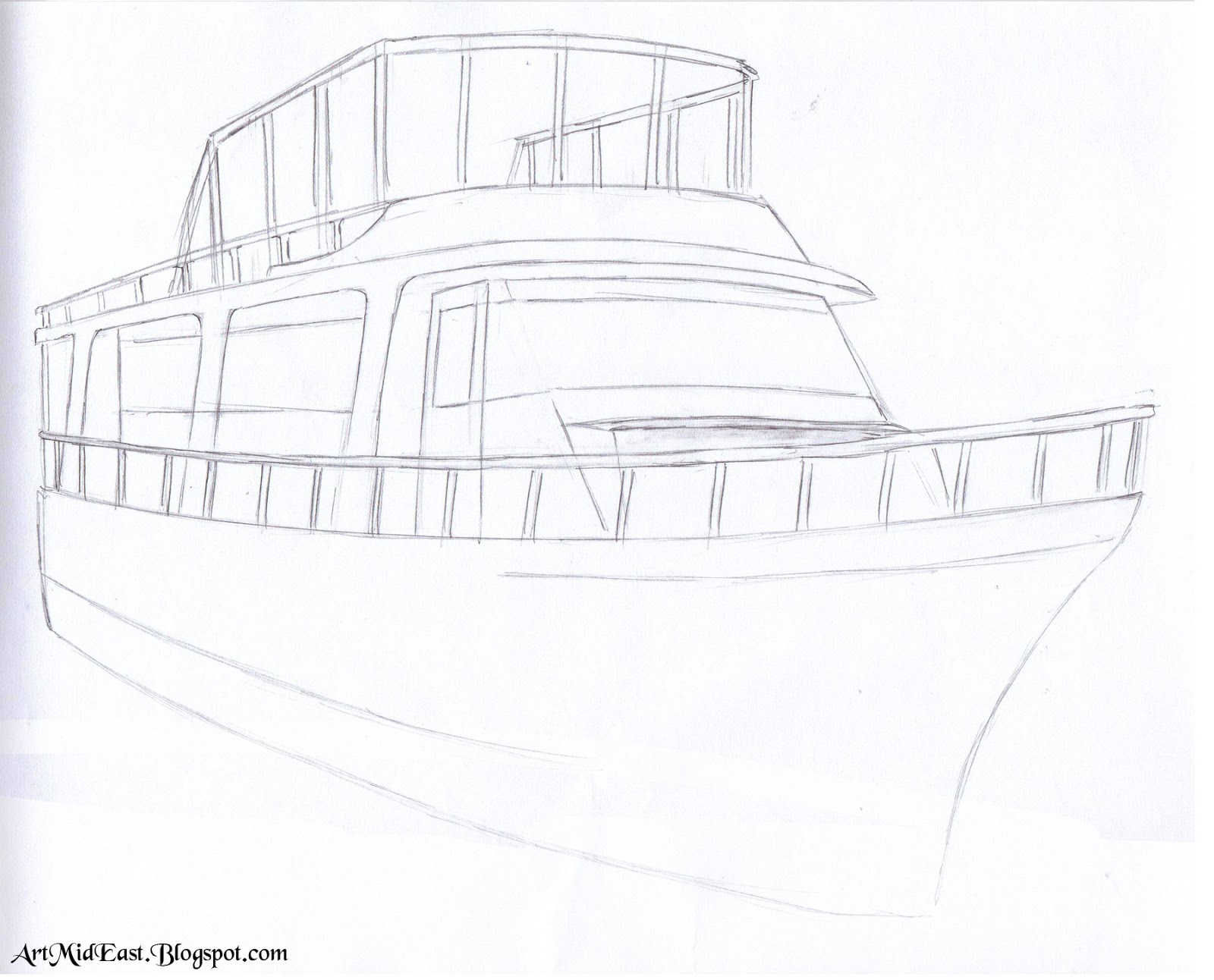
Here I built the extremely simplified, rough sketch of the boat:
What I'm worried about now, is getting the lines in the correct places, especially the longer ones. Also, I make sure the lines are congruent with the perspective (you can try and find the vanishing point on the left, outside the canvas...).
Now its time to add in some details:
I added more to the structure itself, as well as a preparation for the windows and guard rails. All of these details are conforming to the perspective I set up.
Now its time for the real deal:
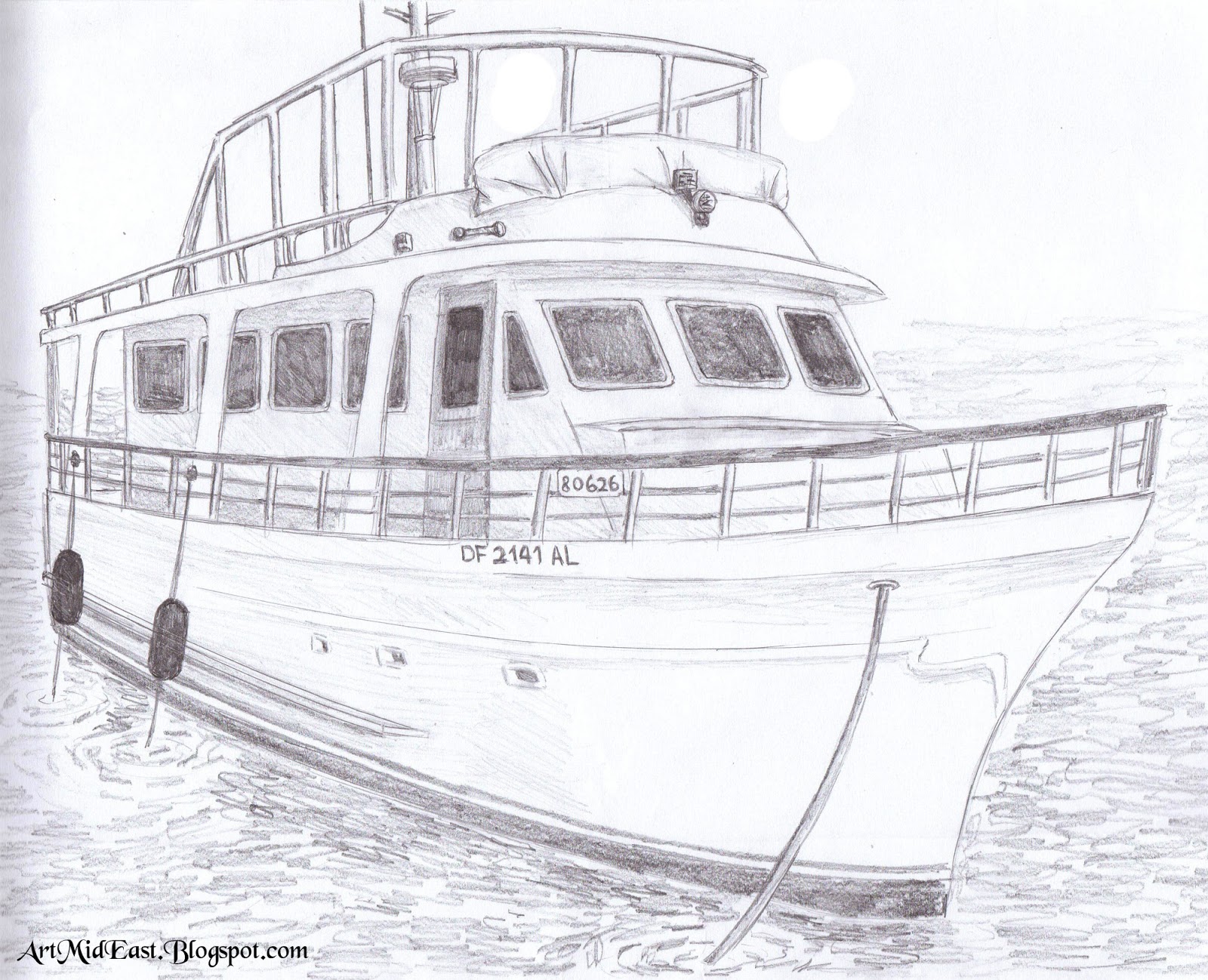
This took the major bulk of my drawing time, since I added so many details and objects to the boat. This is basically the final version BEFORE the shading process. I added, the ropes (including some ripples in the water), the windows, the small signs, the post, some small objects like the lights and horn, and cleaned some unnecessary lines.
----
Check out my new website and subscribe for a FREE eBook! (=
LironYan.com
----
About the windows:
Notice how on the previous step I drew long lines for the windows, and in this step I divided them into the windows and erased the lines. This is a really neat trick for getting many lines correctly, since the windows are at the exact same height.
Now its time for the shading! For a more detailed shading lesson, check out this drawing lesson: Sketching and Shading techniques.
Here are some examples of me shading the door and windows:
A useful tip - put a small piece of paper under your hand, so you won't smear your drawing. This is especially important if you do a pencil shaded drawing, because most of the lines aren't going to be erased!
like this:
I didn't put much thought into the water, and used my instincts to draw them. As you will see in a moment in the final version, I made sure to get some ripples around the ropes, and also the reflection / shadow of the boat's body.
And here is the final version!!
I think this one turned out really cool, and even though I made some minor mistakes on the first steps (with the basic sketch and perspective), it still turned out nice and even a bit realistic.
This is it for today's drawing lesson. Hope this gave you some inspiration to go out and draw your own boats. I suggest going out and actually taking pictures of real boats, and then using them as your reference, which is actually what I've done here!
Next lesson will be very fun, and will discuss a highly requested topic, so keep your eyes open and stay tuned... (;
Also, check out my new website and subscribe for a FREE eBook! (=
LironYan.com
Peace,
- Liron.
Read More
Hey world!
This is a part 2 lesson for my old drawing lesson on How to draw a hand - Clenched fist and open palm. Today's drawing lesson is going to be a more of a step by step guide for drawing hands. You will learn exactly how to approach this subject. This lesson will include explanations of the human hand's anatomy, what are it's proportions, how to draw it IN ANY POSE and give it depth and solidity.
So without further ado, lets get started!
How to draw hands - Step by step guide
Anatomy of the human hand:
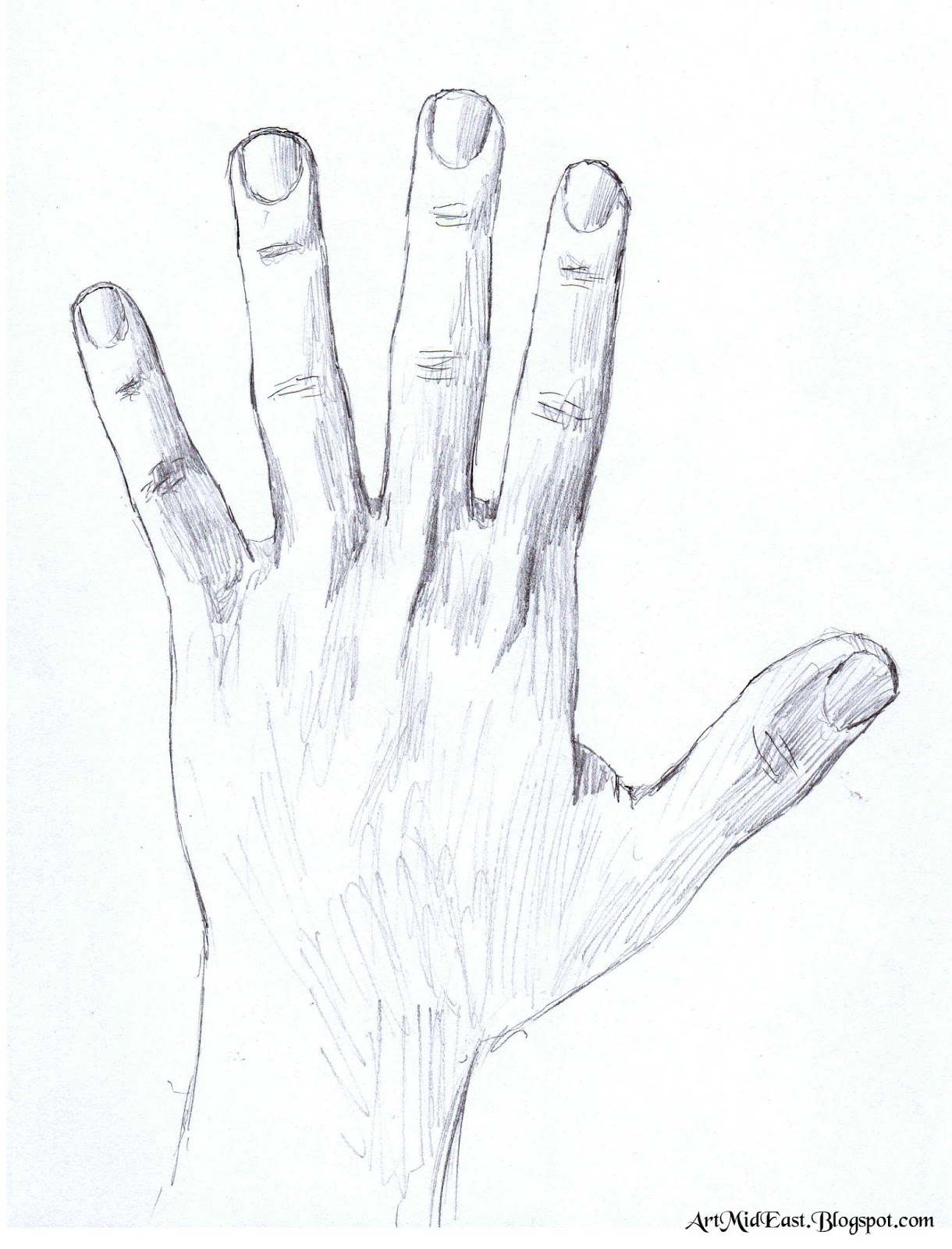
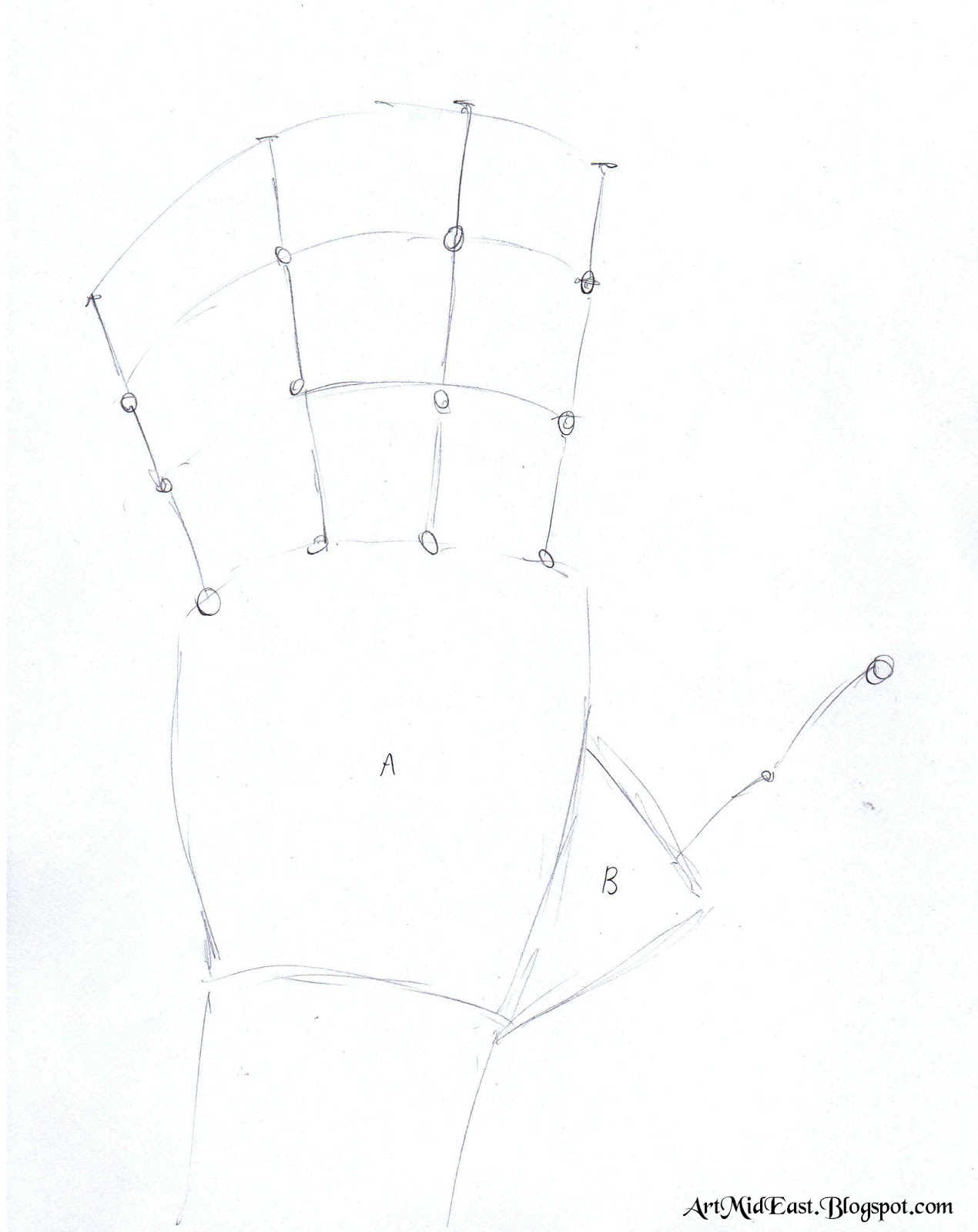
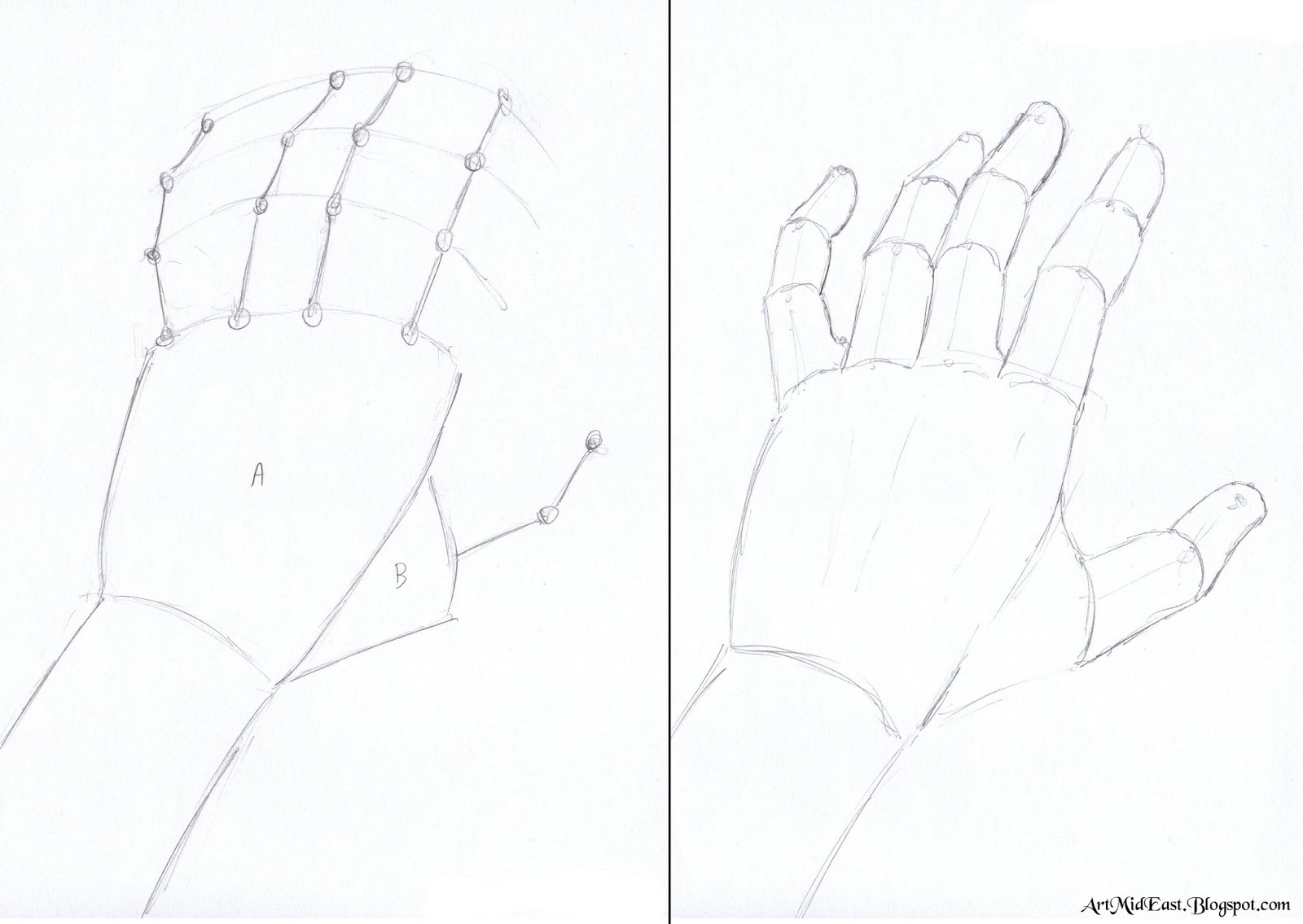
So first, lets learn how the human hand is built. Here is the sketch for the previous drawing.
You can see that that hand is composed of the following parts: part A, part B and the fingers. The overall length of the hand, top to bottom, should be enough to reach from your chin to you hairline. This should give you a good idea on how big the hands should be, which is a major sticking point for many people (including me).
The biggest part of the hand, is the one I marked as part A. Sadly, I can't find a simple "trick", or method of drawing it. I have to actually think while doing so [=. It can help however, to imagine it as sort of a trapezoid. Its inner side (the side closer to B) is longer. After drawing it a couple of times you will kind of get it, and be able to draw it from top, bottom and sideways.
Next is part B. This part connects to the inner side of A (when looking at the hand from top, like both drawings). It also connects to the thumb. Part B is a triangle. Its length (from wrist to beginning of thumb) is about half the length of part A (from wrist to middle finger). After looking at my hands, and many other people's hands, I noticed that its angle is about 40 degrees, but can vary depending on the movement of the thumb.
Now its time for the hardest part - the fingers! Now that's quite a challenge. Check out the fingers on both examples. You can see (as I pointed out on my previous lesson) that the knuckles create a fan. This makes the middle finger the longest, the ring and index fingers almost equal in length, and the thumb and little finger also almost equal in length. Here are a couple of tips for drawing the fingers correctly:
- The Length of the middle finger is about the same as the length of part A.
- The fingers, from longest to shortest: middle, index, ring, thumb and little (together).
- Each finger (except the thumb) is divided into 3 knuckles, with the 3rd (farthest from A) "bended" a tiny bit to the back. For the thumb, the same is true to the second knuckle. Also, the fingers are a bit thicker where the knuckles are.
- The fanning is critical for drawing a correct, realistic looking hand.
- The nails are on top of the 3rd knuckle, and take up about half of it's length.
After we talked about each part individually, lets see how they all connect.
----
Check out my new website and subscribe for a FREE eBook! (=
LironYan.com
----
Hand #1 - Step by step
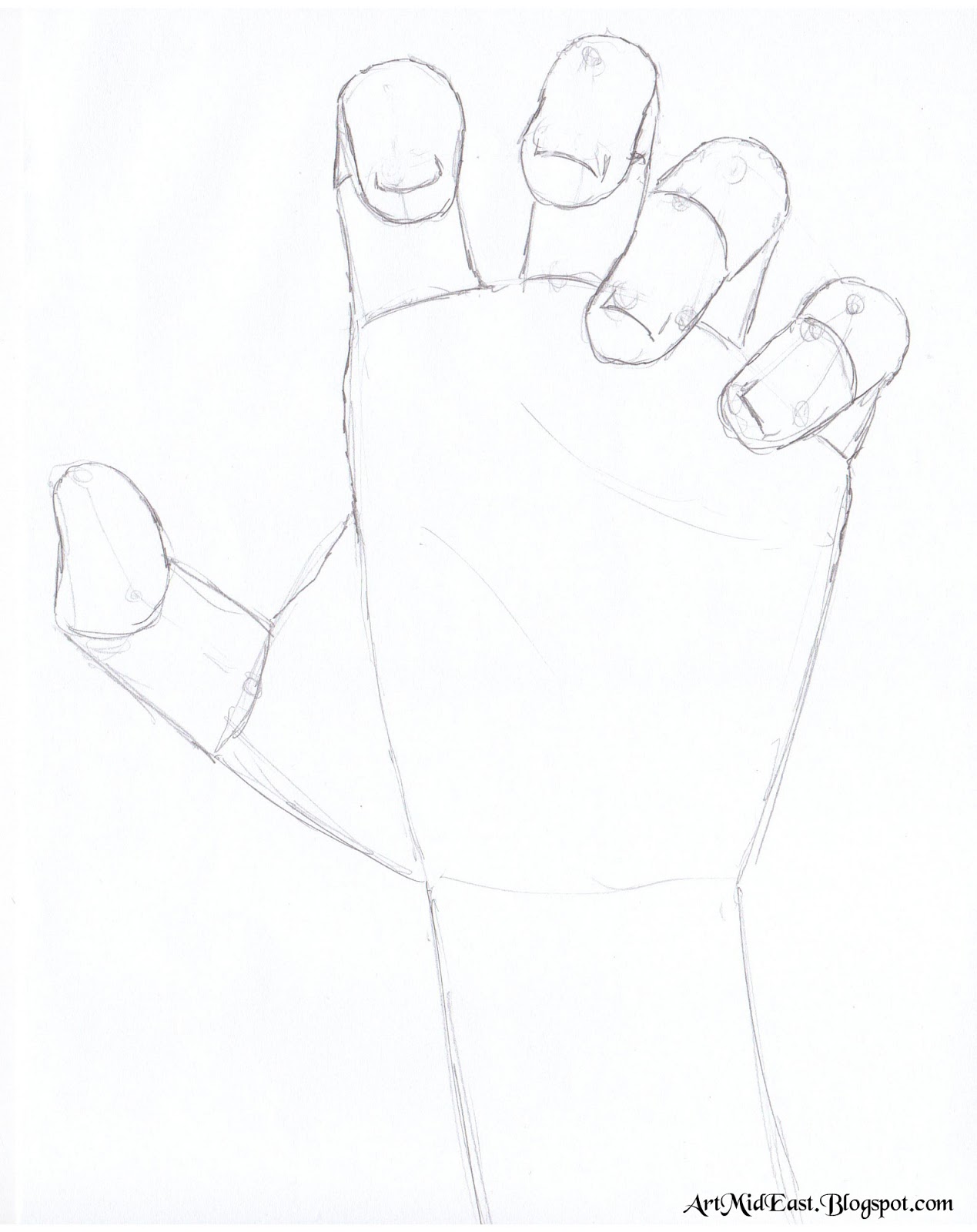
The first hand we are going to draw, will be from the opposite side of the 2 previous drawings, and with the fingers slightly bended (this angle is actually pretty similar to the one from my older How to draw a hand lesson.
Here you can see the wrist, and part A connecting to it. As I've said before, part A is a round trapezoid. I tried to be as simple as I can, and later on we will add more details to this and all of the other shapes.
Here I added part B. Not a whole lot to add, but notice the ~40 degrees angle we've talked about.
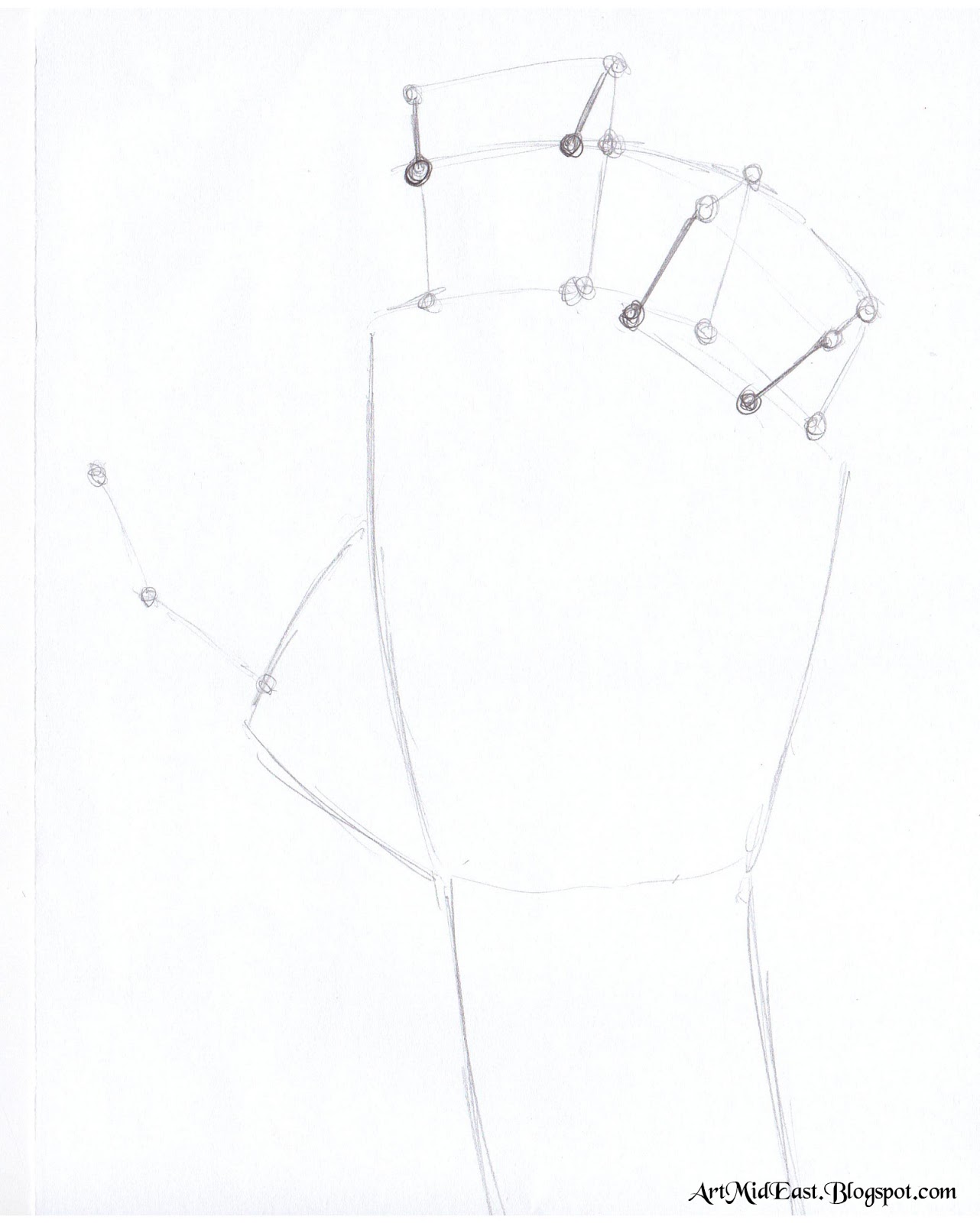
Here I added the first knuckle of each finger, including the thumb. Usually we will start by drawing where the fingers are going to END (so we can gauge their length), but for this example I prefer to do it that way. The most important thing here, is to make sure we get a fan if we were to connect the knuckles.
Here I added another knuckle to each finger. Since the ring and little fingers are very bended, this knuckle is lower then the first one. The index and the middle fingers are only slightly bended. This is a common thing that happens in hands, having the shorter fingers bend more the the longer ones.
Here we added the third knuckle. This time, the index finger's 3rd knuckle is actually blocking our view of the 2nd one. Look at your own hand and see it happening for yourself.
This is the cool part, where we actually make solid fingers, based on the lines we drew up till now. It is important to note again, that the fingers are thicker where the knuckles are (meaning where they bend), and their 3rd knuckle is slightly bended back. I find that this part is actually quite challenging. Another important thing is to take into consideration the foreshortening that occurs with the fingers that are pointing towards us. This affects how the nails look as well. This is also tricky, so take your time building it up, and erase and redraw if necessary.
Here I shaded the hand. Check out my lesson on Sketching and Shading Techniques for more on that. I will just point out that the light source is coming from the left, so the shadows are on the right. This really helps to indicate the nails.
And we are done with this hand
----
Check out my new website and subscribe for a FREE eBook! (=
LironYan.com
----
Hand #2 - Step by step
We are now going to draw a hand in a very natural and relaxed position. This is the way a hand typically looks like, when a person is standing in place.
Here are our A and B parts. Since this is a more relaxed pose, part B is less prominent. Try and look at different hands, and see how this occurs in different angles. Later on, we may see angles in which the thumb, and also Part B, are not visible at all.
Here I added the knuckles, and indicated the fanning that occurs. You can kind of already imagine the fingers.
Here I solidified the fingers, and slightly indicated the thumb's nail. Notice how, again, the shorter fingers are bending MORE then the longer ones.
Two More Examples
Here is an example of turning the sketch into solid objects (mainly the fingers). Its important to remember that these are all cylindrical objects, that have mass, and as such you have to draw them properly.
Here is a colorful example, that will help you understand the sketch better.
--------------------------------
That's it for the examples. I hope this drawing lesson gave you some simple tools that will help you learn how to draw human hands. There are a lot of things to learn, and there are literally infinite angles and poses. This is great, since you are being challenged constantly.
On my next post, I will draw a few more interesting angles of hands, including ones holding objects, just to get your creative juices flowing.
And after that, we are going to mix it up and draw something completely different and surprising.... [=
Check out my new website and subscribe for a FREE eBook! (=
LironYan.com
Good things to come,
Peace,
- Liron
Read More